Friday, December 12, 2008

Busy Guy?------> Simplify!


A few days ago I saw the title of an article on the New York Times web page that immediately got my attention. The article was called "The Simple Life" and it proved to make a strong connection to Henry David Thoreau's thoughts regarding simplicity.

The article spoke about the increasing popularity of a Buddhist monastery in upstate New York; the members of the monastery meditate and do what is called "work practice", or scrubbing toilets, raking leaves, etc., all day long. These people are living very simple and tranquil lives. The particularly interesting part about this monastery is that a large portion of the members do not regularly practice or believe in Buddhism and are everyday Americans. So who are these people and why are they meditating in a monastery?!

"Philipp Malkmus, a 30-year-old consultant for PricewaterhouseCoopers, said the rigorous agenda at Zen Mountain Monastery over the Halloween weekend actually left him refreshed. 'It wasn't fun in the traditional sense, but it was the opposite of my life in New York City and a return to a very uncomplicated way of living,' he said. 'It gave me the rest and relaxation I was looking for.' "

These people want simplicity! Henry David Thoreau spends a lot of time in his novel, Walden, expressing the importance of making our unnecessarily complex lives more simplistic. Thoreau, as Phillip Malkmus had, left the busy city life and found a simpler life elsewhere. In the woods, Thoreau built an extremely basic shelter to live in, only used necessary supplies, and lived mainly in undisturbed solitude. In that type of environment one is able to focus on the important aspects of life and human nature; now many modern day Americans are following the same path.

The article I read stated that the present amount of attendees is shocking; usually the monastery is not even half full. Additionally, the fact that the attendees flowing in are everyday Americans looking for some simplicity says a lot. The individual, the city, the country, and the world have all become more complex. The amount of complexity that humans can take on may be reaching its limit, and people will be forced to begin simplifying their lives by eliminating unnecessary factors. Thoreau would be excited at this idea, for now people will be physically and mentally able explore themselves, the truth of Man, the truth of nature, and the truth of life.

Thursday, December 4, 2008

Into the...Man's Nature?


Last weekend, I watched the movie titled Into the Wild, a film based upon a novel written about the true story of Christopher McCandless, a man who started a new life for himself by hitchhiking across America all the way to Alaska. McCandless burned all of the money in his wallet, left behind most of his possessions, and lived off the land. This was one of the most touching and beautiful movies I have ever seen before, and makes a significant connection to our AS class. McCandless is a great example of modern day connections to transcendentalism; it seems he acts as a modern day Thoreau. In the movie, in fact, one of the few possessions McCandless does carry with him is Thoreau's Walden. There are a numerous amount of connections I could make between the two men and their beliefs; watching the movie, however, specifically turned my attention towards Emerson's "Nature" essay that our AS class read recently.

The reason I decided to focus on "Nature" is because the way the movie is filmed truly connects the two. In "Nature" Emerson writes, "In the wilderness, I find something more dear and connate than in streets or villages. In the tranquil landscape, and especially in the distant line of the horizon, man beholds somewhat as beautiful as his own nature" (4). This passage puts an inspirational idea in my head every time I read it, and I was able to visually see its truth while watching Into the Wild. Every scene where McCandless' character is out in the wilderness, alone, and away from city life, "tranquil landscapes" come alive. When you see this man, immersed in the luscious woods, it is almost as if he is one with nature; the true purity of man's nature becomes visible.

McCandless' character truly seems to reach a certain peace while surrounded by nature, and by the end of the movie, it is evident that he discovers much about himself. Just as Emerson described one would when in the wilderness, man seems to become nothing, yet part of everything at the same time.

The film, Into the Wild, really portrayed the beauty of tranquility and discovery perfectly. Viewing these gorgeous settings that the main character travels through really touched me in the deepest sense possible. Complex thoughts entered my head after the movie was finished, and I certainly was not able to form any solid opinions, yet one simple idea became clear: The relation between the individual and the natural world is something extraordinary...


Sunday, November 23, 2008

You Can Run, But You Can't Hide


I just finished reading the final pages of Emerson's "Self-Reliance" after school and was about to drive home. I got in my car, put on the radio, and began to drive. A song then came on whose lyrics reminded me tremendously of a maxim I had just read in Emerson's essay. The song is titled, "We Don't Have to Look Back Now," by Puddle of Mudd; this song connects to Emerson's belief about "travel."


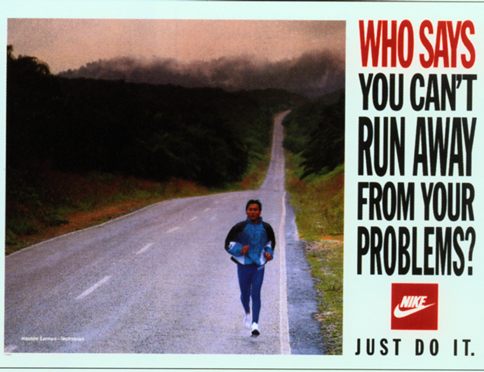
In "Self-Reliance" Emerson writes, "He who travels to be amused, or to get somewhat which he does not carry, travels away from himself, and grows old even in youth among old things" (34). Emerson explains that it is not correct for people to run away from their problems, whatever the issue may be. People often believe that by "fleeing" their problems and going somewhere else, their problems will disappear. Emerson, however, says that if one runs away from their problems, that same problem will continue to find that person, wherever they go. It is, therefore, necessary that people plant their feet and confront their issues. By fleeing, one runs away from themself, and self-reliance no longer exists.

The lyrics to the song I heard seems to oppose Emerson's belief regarding "travel." The chorus to the song is:

"You and I will ride tonight'
Till the past is out of sight
We don't have to look back now
From the dark into the light
We can leave it all behind
We can stand together, we don't have to look back now."

The singer here is saying that he and someone else are confronted by a problematic past. He decides to "flee" their problems by "running" away from the past and leaving all problems behind. It seems very inspirational at the time, but as Emerson discussed, this dude's gonna find out it isn't that simple. Even if these people momentarily "run" away from their issues and leave the past behind, their problems will follow them forever and wherever they go. The only way that these people will be at peace will be to face their past and solve their problems.

The connection between this song and Emerson's writing truly allowed me to reach a great conclusion regarding "travel." I do agree with Emerson that one cannot run away from their problems, but the song inspires me to release myself in a way from the issues I face. I, therefore, have created an efficient compromise between the two beliefs; I will never run from my problems, but I will first release myself from the pressure that those problems present, and then face them.

Sunday, November 16, 2008

Hold Strong to Your Beliefs


This week in AS Class, we read part of Ralph Waldo Emerson's "Self-Reliance." While reading, there was a particular passage that made a fantastic connection to a show I had seen recently. A few weeks ago, I watched a show on NOVA entitled "Einstein's Big Idea." This show described how Einstein's spectacular theory of E=mc^2 came to be. The duration of the show did not focus on the German physicist's discovery of this equation, but more so on the people before Einstein that helped to shape it.

In his book, Emerson wrote, "Pythagoras was misunderstood, and Socrates, and Jesus, and Luther, and Copernicus, and Galileo, and Newton, and every pure and wise spirit that ever took flesh. To be great is to be misunderstood" (25). He is discussing how it is important for people to hold strong to their beliefs, for the world may not understand their thoughts at first, but may eventually. This passage directly relates to the show I watched, as those who contributed to Einstein's famous equation were all misunderstood at first.

I will not go into exact details of the scientific discoveries that these contributors made, but I will explain the basics of their findings. First, an ordinary blacksmith named Michael Faraday, after years of scientific studying and experimenting discovered electromagnetic rotation. A chemist by the name of Antoine-Laurent Lavoiser made important findings regarding the conservation of mass. Emilie Du Chatelet, a french scientist, figured out the relationship between mass and speed.

The point is, is that all of these people were misunderstood by the world when they first announced their discoveries. Faraday was a poor blacksmith, Lavoisier stated a crazy theory, and Chatelet was a female; trusting these people's ideas was not easy for others at first. These individuals, however, never gave up and continued to test their theories. It took months or even years for the scientific world to comprehend these new discoveries, but once it did, a gateway of advancement opened in the scientific world.

Eventually, because these people held strong to their beliefs, the misunderstanding world came to accept and praise the three scientists for their work. Einstein was able to later combine these three theories and form E=mc^2 as a result, one of the most significant scientific formulas ever.

Emerson is truthful when he says that it is important that we have faith in ourselves and our thoughts, and do not cease when challenged by a misunderstanding world; for our individual and unique ideas, like the three scientists' described previously, can one day open the gateway to great, unheard of discoveries.


Link to "Einstein's Big Idea" story: http://www.pbs.org/wgbh/nova/einstein/ancestors.html


Saturday, November 8, 2008

The Divided States of America


Around election day on CNN, I watched Anderson Cooper and his panel of analysts discuss the faults of the Republican party this year. One of the analysts made a very convincing and truthful point, bringing up James Madison's opinion towards factions, and discussed how Sarah Palin created, or tried to create, insulting factions.

James Madison had a strong opinion towards keeping checks and balances on factions, but he also had a deeper opinion as well. He believed political factions are inevitable, but the factions should not lead to cases in which the country is no longer united, but divided.

The analyst agreed strongly with Madison's take on keeping the country united; political factions are necessary, but "American" factions are destructive.
The analyst explained how a large part of Sarah Palin's campaign was describing the "real America."

During one of her many similar speeches, Palin said,"We believe that the best of America is in these small towns that we get to visit, and in these wonderful little pockets of what I call the real America, being here with all of you hard working very patriotic, um, very, um, pro-America areas of this great nation." Palin is, therefore, drawing the conclusion that people who do not live in these small towns and are not these "hardworking" Americans are not patriotic, and even anti-Americans.

This was indeed a huge mistake on Sarah Palin's part, because any voters that didn't fit her small town American description probably isn't going to vote for her. I agree 100% with the analyst when he discussed how political factions are necessary in order to maintain the terrific government we have today. Trying to create a division amongst people describing some as "real Americans" and others as "anti-Americans" is both insulting and plain old foolish when running a political campaign.


Sunday, November 2, 2008

You said I couldn't have any more sugar, but you never said I couldn't have any more candy


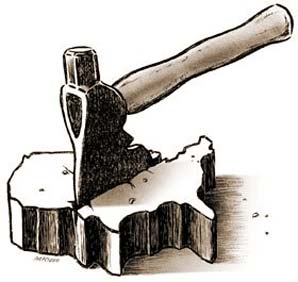
"A well regulated Militia, being necessary to the security of a free State, the right of the people to keep and bear Arms, shall not be infringed."

This is the widely debated 2nd Amendment of the Constitution of the United States. As we discussed in AS class, this sentence can be interpreted in a variety of ways. Not quite sure I have the political stature to fully debate this interpretation yet, but it helps to get some information about why/how this amendment is so controversial.

After our class discussion , I found myself very interested in this topic. I later researched more about Supreme Court Cases and discovered that some decisions in past court cases have been made due to strict following of the Constitution; others seemed to have been resolved using a more modern-day loose and interpretive style of the document. I came upon two terms in my research that clearly define these two styles of interpreting the Constitution: Strict constructionism and loose constructionism.

Strict constructionists, or judicial fundamentalists, believe that people must follow every word of the Constitution without questioning it and do exactly as it says. I learned that Thomas Jefferson was a strict constructionist during his time.

Loose constructionists believe that people should have a liberal interpretation of the Constitution and can act in certain ways as long as the Constitution does not directly forbid it. Another name for loose constructionist is judicial activist. Alexander Hamilton was an example of an early loose constructionist.

I got the two terms down, but then came across probably the most important part that connects these two terms, as well as making an overall connection to our AS class. People choose to be a loose or strict constructionist often based on how they believe our forefathers envisioned the Constitution's roll in the future.

Many strict constructionists believe that when our forefathers created the Constitution, they intended for the document to be followed word for word forever. Present day strict constructionists show pragmatism as they believe that men like Thomas Jefferson created a realistic and straightforward lawful document that should be followed as is.
Loose constructionists think that the forefathers created the Constitution with the intention that it should be left open for change and adjustment in the future. Loose constructionists today practice a type of idealism, as they believe that others like Alexander Hamilton wrote the Constitution as a document that had some leeway to it for future change.

So concerned parents, when your child defies you by using the, "But, you never said I couldn't do this!" line....maybe he/she is just a young and ambitious judicial activist??

Sunday, October 26, 2008

Idealism+Pragmatism=...Beautiful Music?

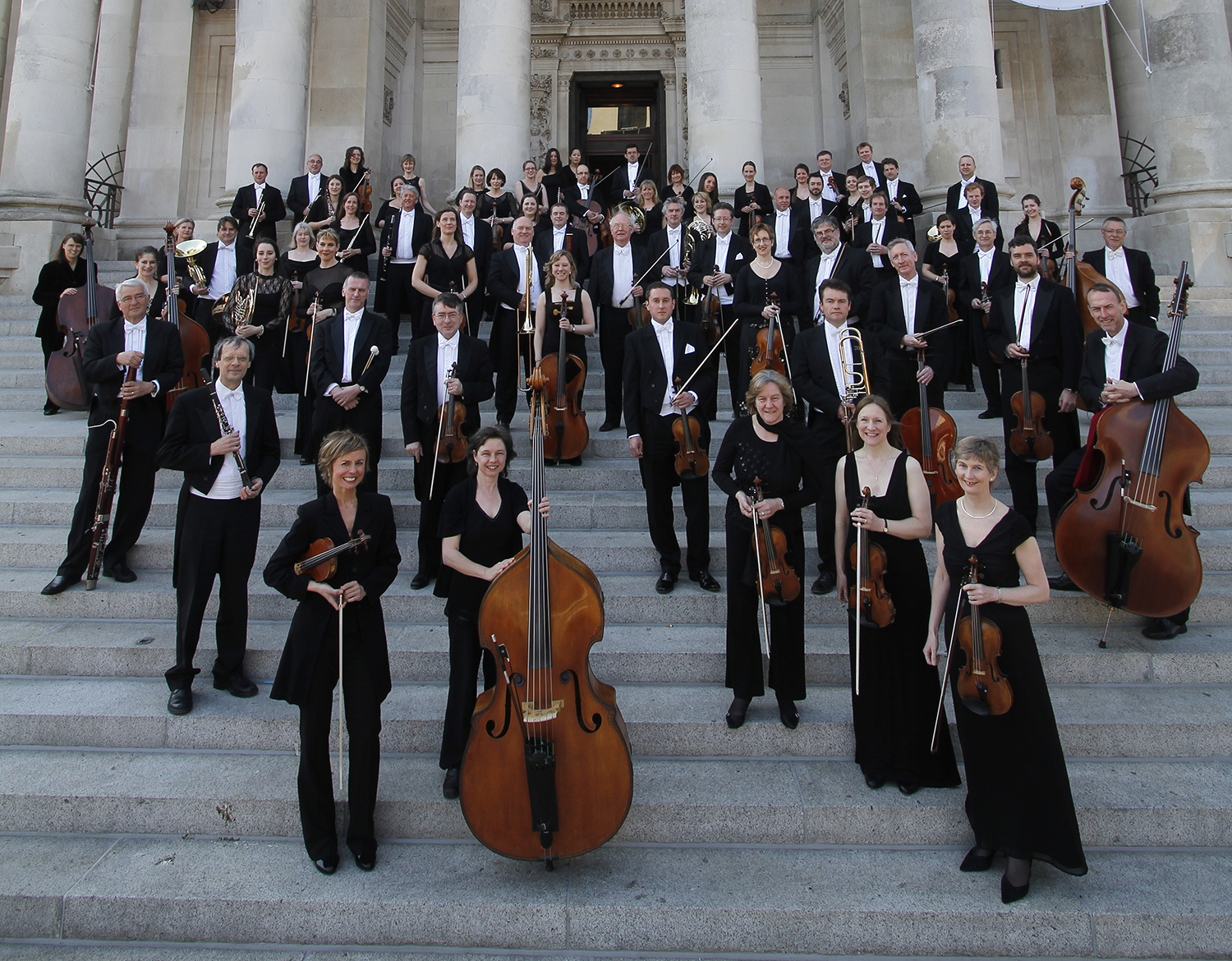
This is the second year I've had the privilege to be a member of the wonderful New Trier High School Symphony Orchestra. This orchestra has been well known for years because of its ability to play very advanced pieces of music and with great professionalism. I remember last year we had very long, difficult pieces to prepare in a short amount of time, but it does not compare to what we have on our belt this year.

On November 13, we are performing two very hard, LONG pieces; one of the pieces, "Carmina Burana", is 25 movements. Then, in December, we are playing three new songs that we have not even gotten the chance to practice yet... Things are not looking good so far.
After rehearsing the hour long "Carmina Burana" that we are not close to being done with, our conductor stopped us and gave a speech at the end of class that really made me think of our AS theme, dreams vs. reality.
"The pieces I chose for you to play this year symphony orchestra are extraordinarily difficult to perfect in the small amount of time we are given. We have a few weeks until we begin rehearsing the entire 'Carmina Burana' with the choir which we are not ready for, we still have to finish Tchaikovsky which we are no where close to, and on top of all that, we have the three pieces to play in December that we have not even looked at. When I decided on the pieces we would play this year, I truly believed that you guys could pull it off, but right now I'm not so sure, maybe I was being a bit idealistic. From now on, I'm no longer going to be Mr. nice guy up here on the podium...It's time to be more pragmatic folks."

After this speech, you could tell our conductor was disappointed, the symphony was disappointed, and things were going to get a little more realistic around here. Although this was quite a...saddening speech, i could not help but give off a little bit of a smile. I knew what was REALLY going on here, and I realized it applies directly to the discussion in AS class of the balance that pragmatists and idealists create.

Every year in symphony, it does seem nearly impossible to play the pieces we play in the amount of time we are given. Each year, no matter how prepared we are, my conductor gives this same speech every time; and although it looks bleak for symphony orchestra this year, I am 100% confident that it will turn out as it always does- nearly perfect.

Here we see the black and white of a balance between pragmatism and idealism that combine to make the New Trier Symphony Orchestra great. First, we are idealists, deciding to pursue pieces that don't seem possible to play in the amount of time we have to rehearse. Then, we are given "the speech" by our pragmatic conductor that tells us to wake up and smell the coffee, explaining the realistic situation of where we stand in terms of being prepared. Soon, everyone in symphony freaks out, starts practicing the pieces of music like crazy until they can perform them almost perfectly. Then, for the next few weeks of rehearsal, the symphony and our conductor dream of accomplishing our goal by the upcoming concerts, while still maintaining a realistic vision of what we must do in order to succeed. When the concert arrives, we are a fully prepared combination of pragmatism and idealism.